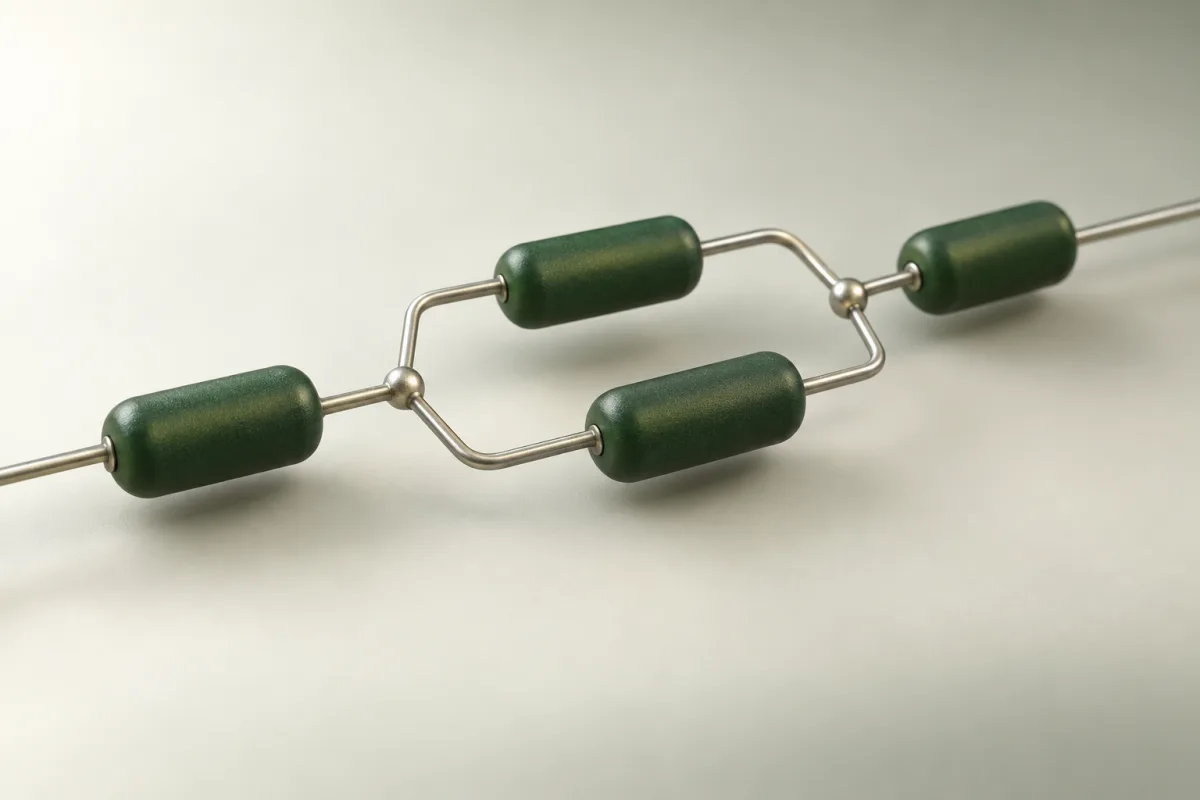
You Don't Have the Resistor Value You Need? Build It From the Ones You Do.
Tell Resistora the resistance or output voltage you need and which resistors you actually have. It tells you what to build when the part you need isn't in the drawer — a substitute, an equivalent standard value, or a divider — searching every series, parallel, and mixed circuit those parts can form, with buildable results ranked by error.
Explore the ToolsResistor and Circuit Calculators
Six tools for finding, designing, and checking resistor circuits — no signup, no install.
Resistor Combination Finder
Get a resistor substitute or equivalent — enter the resistors you have and a target resistance, and Resistora searches every series, parallel, and mixed combination and returns the closest buildable options, ranked by error.
E-Series Resistor Finder
Find the closest standard E6–E192 resistor equivalent to a target value you can actually buy. Pick a series and combination size and get results ranked by error.
Voltage Divider Finder
Get a specific output voltage — like 5V from 12V — from a source. Enter your resistors, source voltage, and target, and get the 2- or 3-resistor divider that lands closest.
Voltage Divider Builder
Already know your resistors and topology? Pick a divider schema, set the values and source voltage, and get the exact output voltage instantly.
Circuit Calculator
Build a resistor network from 16 series/parallel schemas and calculate total resistance, plus combined tolerance, voltage, and power with worst-case min/max bounds.
Series/Parallel Calculator
Quickly calculate the total resistance of resistors in series or parallel, with optional tolerance, voltage, and power ratings.
How Resistora Builds the Value You Don't Have
Why building from what you have beats searching for a part you don't, and a worked example with real numbers.
What to Build When the Value Isn't in the Drawer
Most resistor calculators run forwards: you supply the values and the topology, and they hand back the total. That is the easy direction — a few lines of arithmetic. Design work runs the other way. You start with a number a formula produced — a divider ratio, an amplifier gain, an RC corner frequency — and you have to find some arrangement of real parts that lands on it. Resistora tells you what to build instead: give it the target and the resistors you have, and it returns the circuits that come closest, each with the error it achieves.
Why the Search Space Gets Big Fast
Going backwards is hard because there is nothing to invert. Series adds, parallel combines through reciprocals, and mixed networks nest the two inside each other — so the set of resistances a given parts bin can produce is scattered and non-monotonic rather than a continuous range. Nudging one resistor up does not reliably nudge the total up. The only dependable way to find the best match is to enumerate every candidate and compare.
That is where hand calculation stops working. A bin holding a dozen distinct E12 values, combined across circuits of two to four resistors over the sixteen series, parallel, and mixed topologies Resistora supports, works out to more than 15,000 candidate networks. Evaluating those by hand is a minute or two per candidate and hours for a search you would actually trust. The same search runs in under a second.
A Worked Example: 3.39 kΩ from an E12 Parts Bin
Say you need an RC low-pass with a 1 kHz corner and the capacitor in front of you is 47 nF. R = 1 / (2π f C) gives 3,386 Ω. No standard resistor exists at that value. The nearest E12 part is 3.3 kΩ, which is 2.5% low before its own ±5% tolerance is counted, and E24 offers nothing closer — its neighbours are 3.3 kΩ and 3.6 kΩ.
Two parts from the same E12 bin do considerably better. 2.7 kΩ in series with 680 Ω gives 3,380 Ω — an error of 0.19%, more than ten times tighter than the single nearest standard value. If you would rather not stock a 680 Ω part, 4.7 kΩ in parallel with 12 kΩ gives 3,377 Ω at 0.27%. Both of these beat buying a single 1%-tolerance E96 resistor: the nearest E96 value is 3.40 kΩ, which is 0.41% off.
That is one target against one small bin. Change the capacitor, the corner frequency, or which resistors happen to be in the drawer and the winning combination changes with it. That is the whole reason the search is worth automating rather than working out once by hand.
Run this search on your own parts in the Resistor Combination Finder, or search the full standard catalogue instead of your bin with the E-Series Resistor Finder.
What Makes Resistora Different
Not another calculator that adds up resistors you already picked.
It Tells You What to Build
Every Result Is Buildable from Your Parts
The Same Answer in the Browser and the API
Who Resistora Is For
From a bench parts drawer to a production BOM — anywhere a target value has to come out of real components.
Free to Start, PRO for Deeper Search
Every tool works without an account. PRO adds custom values, deeper E-series, more results, and developer access — and is currently free.
Free
- No registration needed
- Standard E-series values, E6–E96 depending on circuit size
- 2–4 resistors per combination
- Top 3 solutions per search
- All six web tools, full access
- Resistor list saved in your browser (up to 10)
PRO
- Genetic-algorithm combination engine
- Use any custom resistor values
- Deeper E-series at every circuit size, up to E192
- Top 10 solutions per search
- Save up to 25 resistors to your account
- REST API + MCP server access
REST API and MCP Server Access
Run combination search, E-series matching, voltage divider design, and circuit calculations from your own code with a clean REST API — or connect Resistora to your AI assistant through the built-in MCP server. Available on the PRO plan.
View API DocumentationGuides and Reference Tables
Standard Resistor Values — E6 to E192 Reference Tables
Full E6, E12, E24, E48, E96, and E192 standard value tables, decade by decade — the same catalog values the E-Series Finder searches.
Voltage Divider Formula, Derivation & Worked Examples
How a two-resistor voltage divider derives from Ohm's law, with the full formula, a step-by-step derivation, and worked numeric examples.
How to Calculate Parallel Resistance
The parallel resistance formula, the product-over-sum shortcut for two resistors, and why adding branches always lowers total resistance.
Series vs Parallel Resistors — When to Use Which
The difference between series and parallel resistor networks, how voltage and current behave in each, and how to pick a topology for a given circuit.
E-Series Explained: Why 4.7 kΩ Exists and 5 kΩ Doesn't
Why standard resistors only come in specific values like 4.7 kΩ instead of round numbers, and how the E6–E192 logarithmic spacing covers every tolerance band.
Resistor Tolerance and How It Stacks in a Network
What a resistor's tolerance rating actually bounds, and how worst-case error compounds across series, parallel, and mixed networks.
How to Get a Non-Standard Resistance from Standard Parts
Practical methods for reaching a resistance no single standard part provides, by combining resistors you already stock in series, parallel, or mixed circuits.
Resistor Color Code — How to Read the Bands
How to read 4-band, 5-band, and 6-band resistor color codes, including the tolerance and temperature-coefficient bands, with quick-reference tables.
Frequently Asked Questions
- What is Resistora?
- Resistora is a set of web tools for resistor circuit design. Its core function is reverse search: you supply a target resistance or output voltage plus the resistors you have, and it returns the series, parallel, and mixed circuits that land closest, ranked by error. Around that it adds standard E-series matching, voltage divider design, and circuit calculators that report tolerance, voltage, and power.
- What's a resistor substitute or equivalent value?
- A resistor substitute is a combination of resistors from your own parts bin that lands on a value you don't have in stock. A resistor equivalent is the closest standard catalogue value (E6–E192) you could buy instead. The Resistor Combination Finder covers the first case; the E-Series Resistor Finder covers the second.
- Is Resistora free to use?
- Yes. All six web tools work with no account and no install: standard E-series values, circuits of two to four resistors, and the top three solutions per search. A PRO account adds a genetic-algorithm search engine, custom resistor values, deeper E-series up to E192, the top ten solutions, and REST API and MCP access. PRO is currently free.
- Where is my resistor list stored?
- Without an account your list is kept in your browser's local storage, up to 10 resistors. It stays on that device and is not sent to a server. With a PRO account the list is saved to your account and is available wherever you sign in.
- Which Resistora tool should I use?
- If you know the target and want to know what to build from parts you already own, use the Resistor Combination Finder, or the Voltage Divider Finder when the target is an output voltage. If you would rather order the right standard part, use the E-Series Resistor Finder. If you already know the values and the topology and only want the result, use the Circuit Calculator, the Voltage Divider Builder, or the Series/Parallel Calculator.
- Can Resistora work with the exact resistors I have in stock?
- Yes, and that is the default. You enter the values in your parts bin and every circuit returned uses only those values, with quantities respected — no substitutions and no parts you would have to order. Free users pick from the standard value list; PRO accounts can type any resistance, including measured values.
- Why can't an ordinary resistor calculator do this?
- An ordinary calculator runs forwards: you supply the values and the topology and it returns the total. Design work runs backwards — you have a number from a formula and need an arrangement of real parts that produces it. There is no formula to invert, because series adds, parallel combines through reciprocals, and mixed networks nest the two, so the achievable values form a scattered set rather than a continuous range. The only dependable method is to enumerate every candidate circuit and rank the results, which is what Resistora does.
- How accurate are the results?
- The arithmetic is exact for the nominal values you enter, and every solution is reported with its error against your target. Real resistors also carry a tolerance, and the Circuit Calculator and Series/Parallel Calculator propagate per-resistor tolerance, voltage, and power ratings through the network to give worst-case minimum and maximum bounds. Check those bounds against your actual components before you build.
- Can I call Resistora from my own code or an AI assistant?
- Yes. PRO accounts get a REST API that runs the same combination search, E-series matching, voltage divider design, and circuit calculations as the web tools and returns the same structured JSON. There is also an MCP server, so an MCP-capable AI assistant can call the tools directly.